


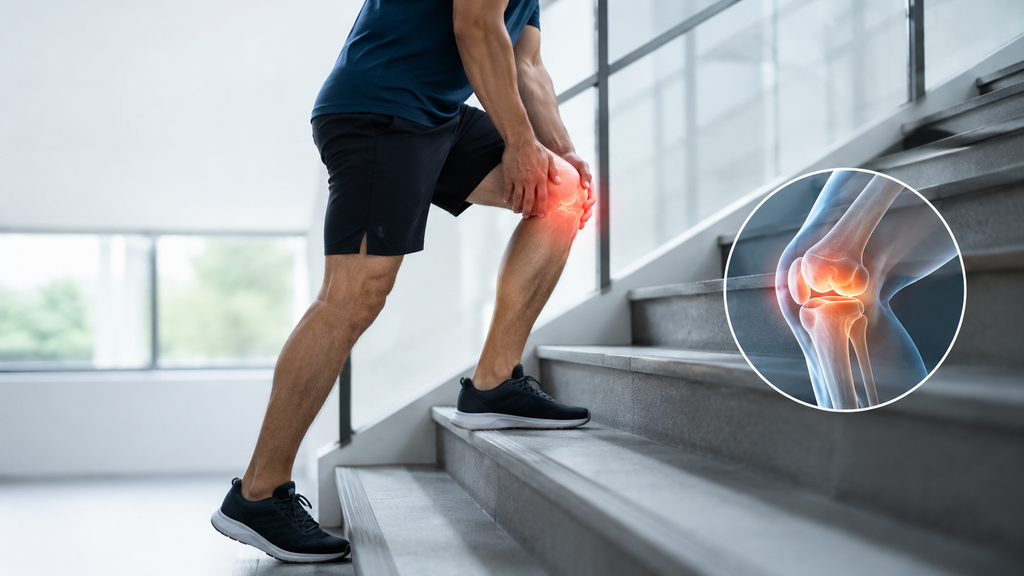
That sharp twinge every time you climb a step isn’t something to shrug off. Knee pain while climbing stairs usually points to stress on the kneecap, weak thigh muscles, or early cartilage wear. Mild cases often improve with rest, stretching, and strengthening exercises. But if the pain lingers, swells up, or makes stairs genuinely scary, it’s worth getting it checked. Left ignored, it can quietly develop into knee joint pain that disrupts your daily life. An orthopedic surgeon can identify the exact cause through examination and imaging, then recommend the right knee pain treatment from physiotherapy to advanced procedures, depending on how far things have progressed.
Why Does Your Knee Hurt When Climbing Stairs? (Common Causes)
Picture this, you’re rushing up the stairs to catch a call, and suddenly your knee sends a jolt that makes you freeze mid-step. Sound familiar? You’re not alone.
Stairs are brutal on your knees. Going up puts nearly three to four times your body weight through the joint, and coming down is even harder on the cartilage. So when something’s slightly off, stairs are usually the first place you’ll feel it.
Here are the usual suspects behind knee pain while climbing stairs:
- Patellofemoral pain syndrome – Often called “runner’s knee,” this happens when the kneecap doesn’t glide smoothly in its groove.
- Weak quadriceps – Your thigh muscles support the kneecap. Weak ones mean more pressure on the joint itself.
- Cartilage wear (chondromalacia) – The soft tissue cushioning your kneecap starts thinning, causing friction with every bend.
- Meniscus tear – A cushioning cartilage tear, often from twisting motions, can make stairs feel unstable.
- Osteoarthritis – Gradual wear and tear of joint cartilage, more common as we age.
- Excess body weight – Extra load multiplies the stress your knees absorb with every step.
- Old injuries – A previous sprain or ligament tear that never fully healed can resurface under strain.
Not every twinge means something serious. But when the discomfort becomes a regular guest, it’s your knee asking for a little attention.
When Should You See a Doctor?
Here’s the thing, ignoring the pain doesn’t make it go away. It usually just gives the underlying problem more time to get worse.
Reach out to an orthopedic surgeon if you notice any of these:
- Pain that persists beyond two to three weeks despite rest
- Visible swelling or warmth around the knee
- A clicking, grinding, or popping sound with movement
- Your knee giving way or feeling unstable
- Difficulty fully bending or straightening the joint
- Pain that disturbs your sleep
- Stiffness that’s worse in the morning and doesn’t ease up
If stairs have become something you actively avoid, that’s a signal too. Think about it — your knees carry you through thousands of steps every single day. When they start protesting loudly, it deserves more than a passing thought.
Treatment for Knee Pain
Most knee troubles don’t demand surgery straightaway. Doctors typically begin with conservative care and escalate only if needed.
Common Approaches to Knee Pain Treatment
| Treatment Option | What It Does | Best Suited For |
| Physiotherapy | Strengthens muscles around the joint, improves flexibility | Mild to moderate pain, muscle weakness |
| Medication | Reduces inflammation and eases discomfort | Short-term flare-ups |
| Knee bracing | Provides support and stability during movement | Ligament instability, mild arthritis |
| Intra-articular injections | Delivers lubrication or anti-inflammatory relief directly into the joint | Moderate arthritis, cartilage wear |
| Arthroscopy | Minimally invasive procedure to repair torn cartilage | Meniscus tears, minor structural damage |
| Joint replacement surgery | Replaces damaged joint surfaces with artificial components | Advanced osteoarthritis, severe joint damage |
A good knee pain treatment plan isn’t one-size-fits-all. It’s built around your specific cause, your activity level, and how much the pain is affecting your daily routine.
How to Avoid Knee Pain When Climbing Stairs?
Prevention genuinely beats cure here, and it doesn’t require anything drastic.
- Strengthen your quads and hamstrings – Simple exercises like leg raises and wall sits go a long way.
- Warm up before activity – Cold, stiff joints are more prone to strain.
- Use the handrail on stairs – It reduces direct pressure on your knee joint.
- Wear supportive footwear – Poor shoes shift how weight travels through your legs.
- Maintain a healthy weight – Every extra kilo adds multiplied pressure on your knees while climbing.
- Avoid twisting motions – Especially when your knee is bent and bearing weight.
- Take breaks on long staircases – Don’t rush through multiple flights without pausing.
Small, consistent habits protect your joints far better than any quick fix ever could.
Knee Arthritis Symptoms
Since arthritis is one of the most common reasons behind stair-related discomfort, it deserves its own spotlight.
Watch for these knee arthritis symptoms:
- Dull, aching pain that worsens with activity, especially stairs
- Stiffness after sitting for long periods or first thing in the morning
- Swelling around the joint
- A grating or grinding sensation during movement
- Reduced range of motion over time
- Pain that fluctuates with weather changes
Arthritis doesn’t appear overnight. It creeps in gradually, which is exactly why people tend to dismiss the early signs. Catching it early gives you far more treatment options and a much better long-term outlook.
Results & Recovery Timeline
Recovery genuinely depends on what’s causing the pain and which treatment path you take.
- Muscle strain or mild strain: Usually improves within one to two weeks with rest and stretching.
- Patellofemoral pain syndrome: Physiotherapy typically shows results in four to six weeks.
- Meniscus tear (minor): Non-surgical recovery can take six to eight weeks.
- Arthroscopic surgery: Most patients resume light activity within two to three weeks, full recovery by two to three months.
- Joint replacement: Recovery spans three to six months, with steady improvement in mobility throughout.
Patience matters here. Rushing back to stairs and heavy activity too soon often undoes the progress you’ve made.
FAQs
1. Why does my knee hurt only when climbing stairs, not walking?
Stairs put far more pressure on the kneecap than flat walking does, which is why joint issues often show up specifically on stairs first.
2. Is knee pain while climbing stairs always a sign of arthritis?
Not necessarily. It could be muscle weakness, cartilage irritation, or an old injury flaring up. An examination helps confirm the actual cause.
3. Can exercise make knee pain worse?
The wrong exercises can, but the right strengthening routine, guided by a professional, usually helps rather than harms.
4. How long can I try home care before seeing an orthopedic surgeon?
If there’s no improvement after two to three weeks, or if symptoms worsen, it’s time to get it evaluated instead of waiting further.
5. Does knee pain treatment always involve surgery?
No. Most cases respond well to physiotherapy, medication, and lifestyle changes. Surgery is reserved for advanced or unresponsive cases.
6. Are knee arthritis symptoms reversible?
Cartilage damage itself can’t be fully reversed, but symptoms can be managed effectively, and progression can be slowed significantly with early care.
7. What tests help diagnose knee joint pain?
X-rays check bone alignment and joint space, while MRI scans reveal soft tissue, cartilage, and ligament damage in detail.
Conclusion
Your knees do a lot of quiet, unglamorous work every single day, and stairs are often where their struggles show up first. Don’t wait for knee joint pain to turn into something that limits your independence. Whether it’s a nagging ache or a sharp jolt with every step, getting the right knee pain treatment early makes recovery smoother and faster.
If stairs have started feeling like an obstacle course instead of a routine, it’s time to talk to a specialist. At Sai Sanjeevini Super Speciality Hospital, one of the trusted names for orthopedic hospital in Hyderabad, our team, led by Dr. S. Anjaiah (M.S. Ortho), focuses on accurate diagnosis and treatment plans tailored to you, not a generic checklist.
Related Reads:
- Can Migraine Be a Sign of a Brain Problem?
- 10 Early Brain Stroke Symptoms You Shouldn’t Ignore
- When Does Back Pain Need an Orthopedic Doctor?
- Our Specialities & Treatments
Don’t let knee pain hold you back.
Book a consultation with our orthopedic specialists at Sai Sanjeevini Super Speciality Hospital today, and get back to climbing stairs without a second thought.