


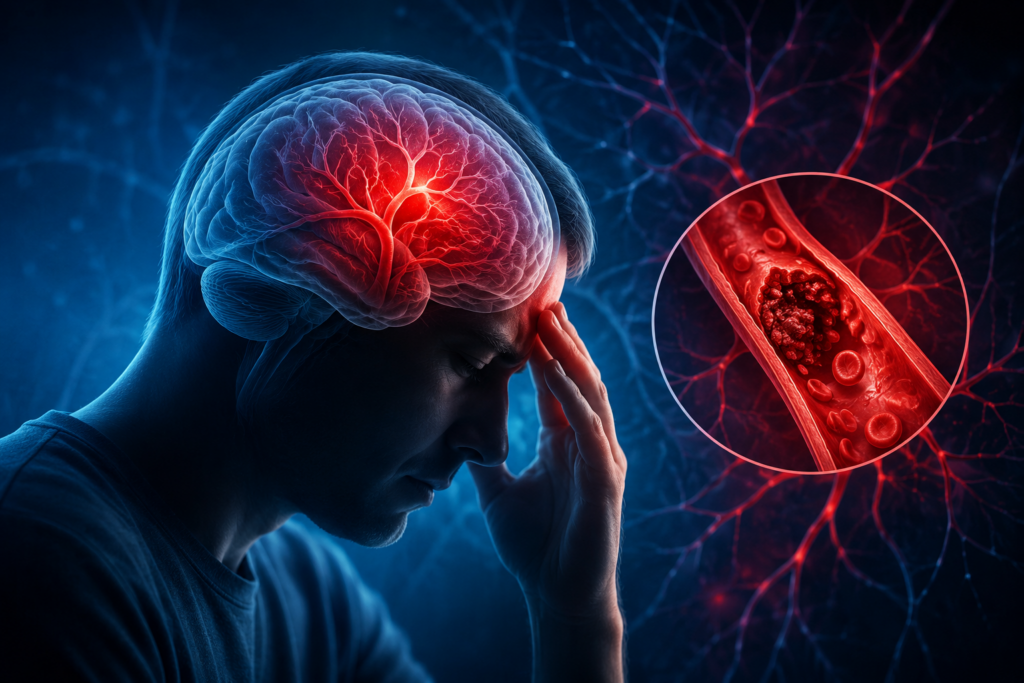
A stroke occurs when blood flow to a part of the brain suddenly stops, and nearly two million brain cells are lost with every passing minute. The most common early brain stroke symptoms include drooping of the face, weakness in one arm or leg, slurred speech, sudden confusion, blurred vision, a severe headache, dizziness, difficulty swallowing, numbness on one side of the body, and sudden fatigue. If even one of these brain stroke warning signs appears, immediate medical attention is essential. Treatment within the first 4.5 hours — known as the golden window, can save a life and prevent permanent disability.
What Is a Brain Stroke?
A stroke is a medical emergency in which the blood supply to a part of the brain is interrupted, either by a blockage or by bleeding. Deprived of oxygen, brain cells begin to die within minutes. The area of the brain affected determines which functions are lost — speech, movement, vision, memory, or balance.
This is why stroke specialists follow one guiding principle: time is brain. The earlier the early signs of brain stroke are recognised and treated, the greater the chance of a full recovery.
It is also important to correct a common belief. Stroke is not limited to the elderly. Emergency departments across Hyderabad now regularly receive patients in their 30s and 40s — working professionals with high stress, irregular routines, and undiagnosed blood pressure. Awareness, therefore, matters at every age.
10 Early Symptoms of a Brain Stroke
Consider a familiar scene. A 52-year-old man is having dinner with his family. Midway through the meal, his glass slips from his hand. His words turn unclear. His family assumes it is tiredness and helps him to bed. By morning, the right side of his body no longer moves.
Stories like this unfold every day — not because families do not care, but because they do not recognise the warning. These are the ten signals that should never be dismissed.
1. Drooping of the Face
One side of the face suddenly sags or feels numb. When the person attempts to smile, the smile appears uneven. This is one of the most recognisable danger signs.
2. Weakness in an Arm or Leg
When both arms are raised, one drifts downward or feels limp. Patients often describe the limb as suddenly feeling heavy or lifeless.
3. Slurred or Unclear Speech
Words become jumbled and sentences lose meaning. If a person cannot clearly repeat a simple phrase, urgent evaluation is needed.
4. Sudden Confusion
The person may abruptly forget where they are, struggle to understand simple questions, or lose track of a conversation. This sudden mental fog is among the most frequently overlooked early brain stroke symptoms.
5. Vision Problems
Blurred, double, or darkened vision in one or both eyes, appearing without warning. Some patients describe it as a curtain falling across their sight.
6. A Sudden, Severe Headache
An intense headache that strikes without warning often described as the worst headache of one’s life may indicate bleeding in the brain, especially when accompanied by vomiting or a stiff neck.
7. Dizziness and Loss of Balance
Sudden unsteadiness, a spinning sensation, or difficulty walking without any clear cause can signal reduced blood flow to the brain.
8. Numbness on One Side of the Body
Tingling or complete loss of sensation in the face, arm, or leg — typically on one side only. This one-sided pattern is a classic feature of stroke.
9. Difficulty Swallowing
Choking on liquids or a sensation of food being stuck in the throat may indicate that the brainstem is affected.
10. Sudden, Unexplained Fatigue
Overwhelming exhaustion that appears abruptly, sometimes with nausea or persistent hiccups — a presentation seen more often in women — warrants medical attention.
Remember the Word: BE FAST
| Letter | What to Check |
| B — Balance | Sudden loss of balance |
| E — Eyes | Sudden vision changes |
| F — Face | Drooping on one side |
| A — Arms | Weakness in one arm |
| S — Speech | Slurred or strange speech |
| T — Time | Seek emergency care immediately |
A note on mini strokes:
These symptoms sometimes appear and resolve within minutes. This is a Transient Ischaemic Attack (TIA). Mini stroke symptoms are the body’s final warning. Up to one in five people who experience a TIA suffer a full stroke within 90 days. Their disappearance is not relief; it is a signal to consult a doctor the same day.
What Causes a Brain Stroke?
Most strokes are the result of damage that builds silently over years. The common causes include:
- A blood clot that travels to the brain and blocks an artery
- Fatty deposits (plaque) that narrow blood vessels due to prolonged high cholesterol
- A ruptured blood vessel, usually caused by long-standing, uncontrolled blood pressure
- An irregular heartbeat (atrial fibrillation), which allows clots to form within the heart
- Uncontrolled diabetes, which gradually damages the walls of blood vessels
- Smoking and excessive alcohol use, which thicken the blood and harden the arteries
A stroke may feel sudden, but it rarely is. It is usually the final chapter of a story written quietly over a decade.
There is also a lesser-known danger. Silent stroke symptoms are so subtle — minor memory lapses, slight clumsiness, small changes in mood that they are often mistaken for normal ageing. These hidden strokes are detected only on brain scans, yet they significantly raise the risk of a major stroke in the future.
Types of a Brain Stroke
There are three main types of stroke, and the treatment approach depends on which one has occurred:
| Type | What Happens | How Common |
| Ischaemic stroke | A clot blocks blood flow to the brain | About 85% of cases |
| Haemorrhagic stroke | A blood vessel bursts and bleeds into the brain | About 15% of cases |
| TIA (mini stroke) | A temporary blockage that clears on its own | A serious warning, not a lucky escape |
When mini stroke symptoms — brief weakness, momentary slurring of speech, or short-lived vision loss resolve quickly, they are frequently ignored. This is a costly mistake. A TIA is the one warning the body offers in advance. Similarly, because silent stroke symptoms may give even less notice, regular health screening is essential for anyone with risk factors.
Risk Factors: Who’s at Greater Risk?
The risk of stroke is higher in individuals with:
- High blood pressure — the single largest contributing factor
- Diabetes or prediabetes
- High cholesterol
- A smoking or tobacco-chewing habit
- Obesity and a largely sedentary lifestyle
- A family history of stroke or heart disease
- Age above 55, although strokes in younger adults are rising sharply across India
- Chronic stress and inadequate sleep
Individuals with two or more of these factors benefit greatly from a preventive neurological evaluation, even in the absence of symptoms.
Diagnosis and Treatment
How Doctors Confirm a Stroke
From the moment a suspected stroke patient arrives, every minute is accounted for. The standard evaluation includes:
- CT scan or MRI of the brain to determine whether the cause is a clot or a bleed
- Blood tests to assess sugar levels, clotting function, and cholesterol
- ECG and echocardiogram to identify heart-related sources of clots
- Carotid Doppler to examine the arteries of the neck
How Strokes Are Treated
Treatment depends on the type of stroke and, critically, on how quickly the patient reaches the hospital:
- Clot-dissolving medication (thrombolysis): Administered within 4.5 hours of symptom onset, it can dissolve the clot and significantly reduce disability.
- Mechanical thrombectomy: For larger clots, specialists remove the clot through a thin catheter — effective for up to 24 hours in selected patients.
- Surgery for bleeding strokes: Haemorrhagic strokes may require neurosurgery to relieve pressure or repair the damaged vessel.
- Preventive medication: Blood thinners, blood pressure medication, and cholesterol-lowering drugs to prevent recurrence.
At Sai Sanjeevini Super Speciality Hospital, the neuro surgery and critical care teams are supported by a 24/7 emergency wing, laboratory, radiology, pharmacy, and ambulance service because managing the symptoms of brain stroke is a race against time, and the hospital is structured to win it.
Results & Recovery Timeline
Recovery after a stroke is a journey, and it is one filled with genuine hope. The brain possesses a remarkable ability to form new pathways — a property known as neuroplasticity — which allows healthy regions to gradually take over lost functions.
| Phase | Timeline | What to Expect |
| Hospital care | Day 1–7 | Stabilisation, ICU monitoring, and early physiotherapy |
| Early recovery | Week 2–12 | The fastest gains — speech, movement, and swallowing improve |
| Ongoing rehabilitation | 3–6 months | Steady progress with physiotherapy and speech therapy |
| Long-term recovery | 6–18 months | Slower but continued improvement; healthy habits protect the gains |
Patients who reach the hospital early, commit to rehabilitation, and keep their blood pressure and sugar under control frequently return to independent, fulfilling lives. Many walk unaided within months. Some return to work. The single greatest factor separating these outcomes from lifelong disability is the speed of the first response.
FAQs
1. What are the earliest signs of a brain stroke?
Drooping of the face, weakness on one side, slurred speech, sudden confusion, and vision loss are the most common early signs of brain stroke. Even a single symptom is sufficient reason to seek emergency care.
2. Can stroke symptoms come and go?
Yes. Brief episodes that resolve within minutes are known as TIAs or mini strokes. They are serious brain stroke warning signs of a larger stroke ahead and require medical evaluation the same day.
3. What are silent strokes?
Silent strokes damage small areas of the brain without producing dramatic symptoms — perhaps mild forgetfulness or slight clumsiness. They are usually discovered on brain scans and quietly increase the risk of a future major stroke.
4. What should be done if someone shows symptoms of brain stroke at home? Note the exact time the symptoms began, avoid giving food, water, or medicine, and take the person immediately to the nearest hospital with 24/7 neuro emergency care. Waiting to see if the symptoms improve is the most dangerous choice.
5. Is a stroke curable if treated early?
Many patients recover remarkably well when treated within the 4.5-hour golden window. Timely clot-dissolving therapy prevents lasting disability in a large proportion of cases.
6. Can young people get strokes?
Yes. Rising stress, smoking, hypertension, and sedentary work culture mean early brain stroke symptoms now appear in adults under 45 more frequently than ever before in India.
7. How can a stroke be prevented?
Control blood pressure and sugar, avoid tobacco, walk for 30 minutes daily, reduce salt and fried food, maintain good sleep, and undergo regular health check-ups — particularly if stroke runs in the family.
Conclusion
A stroke gives little notice. It interrupts an ordinary morning, an office meeting, or a family dinner. Yet the outcome of that moment is decided long before it arrives by whether the people in the room recognise what they are seeing.
Awareness is the strongest protection before a stroke, and speed is the strongest medicine after one. Recognising early brain stroke symptoms in time does more than preserve brain cells; it preserves independence, dignity, and the years that follow.
If these brain stroke warning signs ever appear in a loved one, minutes matter more than anything else. Even mild or short-lived symptoms of brain stroke deserve a doctor’s evaluation — never a wait-and-watch approach.
Related Pages You May Find Helpful
- Our Specialities – Neuro Surgery & Critical Care
- Facilities – 24/7 Emergency, Lab, Radiology & Ambulance
- About Sai Sanjeevini Super Speciality Hospital
Book a Consultation
Whether a symptom has appeared, a mini stroke has occurred, or a preventive neurological check-up is due, timely expert care makes all the difference. The specialists at Sai Sanjeevini Super Speciality Hospital, Dilsukhnagar, are available round the clock.
📞 Call Now: +91 88971 61616 📍 Visit Us: Plot No. V–7, NH–9, Narsimhapuri Colony, Kothapet, Saroornagar, Hyderabad – 500035
👉 Book Your Consultation Today — because when it comes to the brain, every moment counts.